Robert Willard is a PhD student at the University of Vienna, in the department of Near Eastern Studies. His current research focuses on the use of heritage as a framework for practicing and maintaining water governance in Western Uzbekistan. Robert has 10 years of experience in ecological advocacy and fieldwork in Uzbekistan, in partnership with Webster University, the University of Pisa and the World Aral Region Charity. Robert obtained an MSc in Sustainability Studies from IHE Delft and a BA in Economics at Columbia University.
The Amu Darya is a transboundary river basin spanning Kyrgyzstan, Tajikistan, Afghanistan, Turkmenistan, and Uzbekistan. Its downstream section, an arid and unstable terrain, has always been in flux1. It carries rich alluvial sediment from the the upstream Pamir mountains, to fertile floodplains downstream. Over the last two centuries, Russian colonial projects, as well current development practices, have sought to understand the river’s history in order to expand the irrigated area of the oases. The resulting desertification of the basin, most emblematic in the disastrous shrinking of the Aral Sea, speaks to the consequences that such research discourses can have.
The topography of the basin carries the imprint of a shifting river basin. The right bank of the lower Amu Darya River, across from Urgench, is dotted by archaic canal systems that date to the fourth century BCE, when the Amu Darya flowed north via its tributary, the Aqcha Darya. After the zone dried out in the 10th century AD, Khorezmians resettled to the left bank. These irrigation systems reveal long-term strategies through which societies have negotiated environmental variability and climatic change2.
In the early modern period under the Khivan Khanate (16th century–1873) and later Imperial Russian control, the region was home to segmentary and non-segmentary Turkic groups today known as Uzbeks, Qaraqalpaqs, Turkmens and Kazakhs. These different communities carried different livelihoods including nomadic pastoralism, fishing and settled agriculture. Canal upkeep was dependent on collective corvée labour, an obligatory tribute of manpower to dredge or expand main canals, organized under the Khanate. Hydraulic governance was distributed among kinship networks.
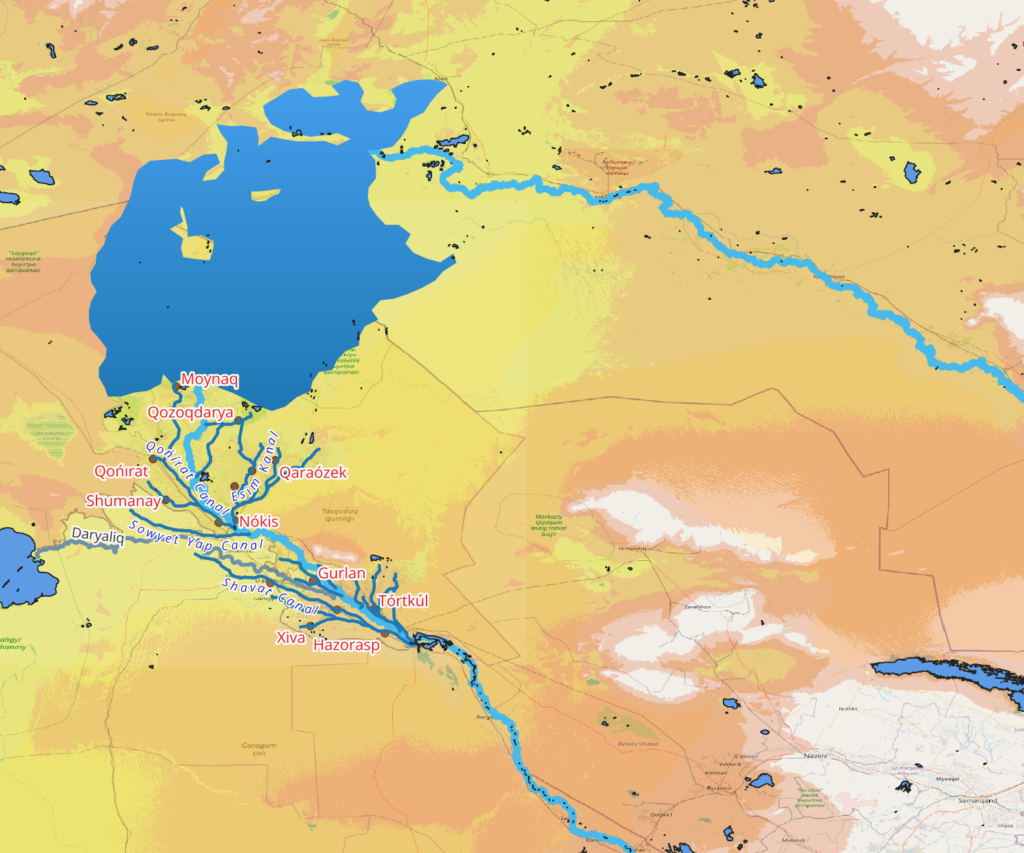
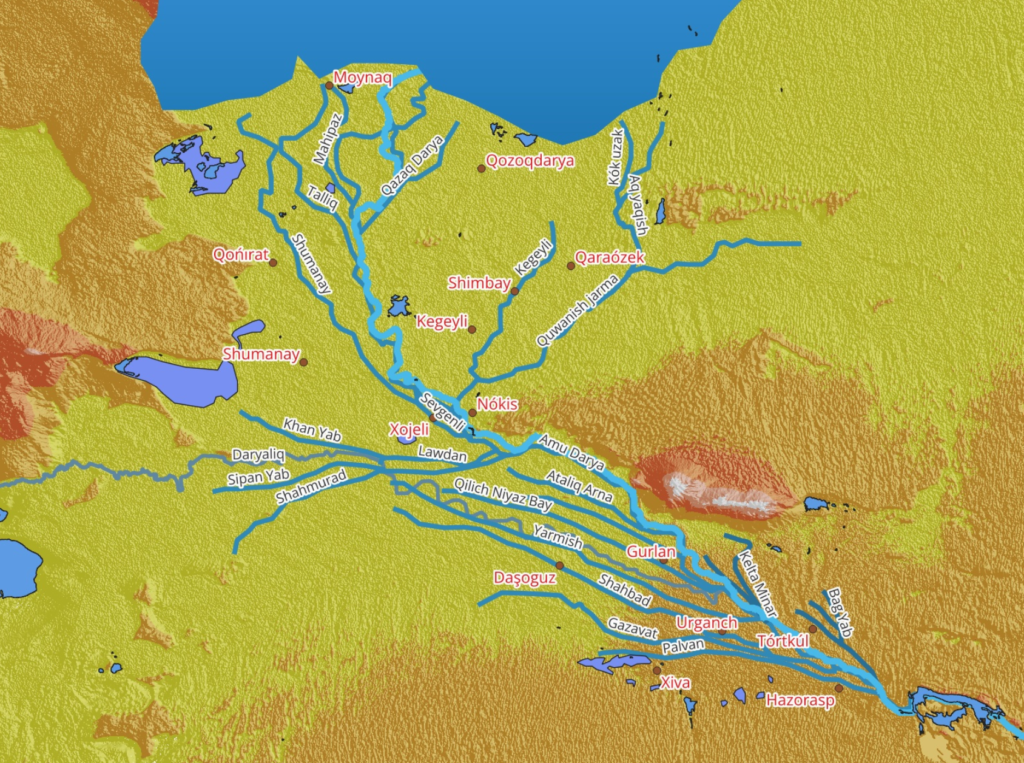
Figures 1 and 2: The Aral Basin and Lower Amu Darya Basin in the 19th century
Data Source: OpenStreetMap contributors (© OpenStreetMap contributors), NASA Earthdata DEM, Guliamov (1957). Adapted by R. Willard (2026)
Russian Imperial Interest
Russian interest in Central Asia’s water sources stems back to Peter the Great, who proposed an expedition to find the end of the Amu Darya3. In 1843, Admiral Aleksey Butakov was sent to chart out the Aral Sea and its environs. Butakov’s map, alongside the renditions of the accompanying painter (and future national poet of Ukraine), Taras Shevchenko, reveal an expansive flood plain south of the Aral Sea alongside dynamic local economies.
In 1873, the lower Amu Darya basin was brought under Russian control with the occupation of the Khivan Khanate by General von Kaufman4 . The left bank was fashioned into a vassal state, and the right bank was incorporated into the Turkestan governorship. A team of ethnographers were subsequently sent by Russia to survey the basin’s people, water, and land. Many marvelled at the productivity of Khivan agriculture. For example, the agronomist Orest Shkapski5, invited to document local farming techniques, remarked that: “Drought which kills the crop and brings about famine in our Russia, is unknown to the Khivans”5.
Following the global fall in cotton supply due to the US Civil War (1861-1865), the American strain of cotton, easier to harvest though more demanding of water, was introduced as a profitable cash crop6 . With traditional water networks largely kept in place, visiting experts such as Alexander Kaulbars7 and Alexander Kuhn8 revealed a basin not serving its full agricultural potential. St. Petersburg thus justified the expansion of irrigated zones and cotton production via these ethnographic and agronomic studies. For example, attempts were made to revive areas to the west of Khiva, bordering the Karakum desert, on the justification that they follow the contour of former irrigation canals, cut off by the Khivan Khan 9 10. Historical research showed that the western zone of the Saryqamysh depression had once taken much of the water flowing to the Aral. Nevertheless, desertification was already somewhat observable in the Aral Basin, with researcher Alexander Voyekov warning that, the more the region was irrigated, “the less there is water for the Aral, and the smaller it will become” 11.
The Early Socialist Period
Following the Bolshevik Revolution and Russian Civil War (1917-1922), the full region was incorporated into the Soviet system. The southern left bank between Khorezm region and the northwestern right bank became the Autonomous Republic of Qaraqalpaqstan, an ethnically mixed region within the Uzbek Soviet Socialist Republic.
In these reformatted territories, the expansion of Central Asia’s irrigation system became a centrepiece of its domestic policy, born out of hopes at modernising its “third world” status, and increasing production of much needed cotton12. To understand the dynamics of Central Asian water systems, the government encouraged research into the history and ethnography of irrigation in the Aral Basin. In 1924, the Bulletin of Irrigation, a monthly journal in early Soviet Central Asia, published a detailed study of traditional Islamic rules for water-use in the region13. In 1937, under the leadership of archaeologist Sergei Tolstov, a major expedition was organised to document the irrigation of desert areas in Khorezm, on the right bank from Urgench. The Khorezm Ethnographic and Archaeological Expedition was partially funded by collective farming enterprises, which were required to survey the land before it was developed for large-scale cotton plantations.
Although the USSR’s mass construction projects already had a visible toll on the environment in the 1940’s, many works produced by the expedition did not view these effects as harmful in the long run. When some scholars did warn of the fragility of the Aral Basin ecosystem, they were mostly dismissed by the mainstream Soviet scholarship14. For example, in reaction to the American geographer Ellsworth Huntington’s warnings of the region’s desertification due to over-development Soviet scholar Boris Andrianov lamented “bourgeois metaphysical sciences” and asserted that agricultural work in Central Asia “has not only a past, but also a future, and can be brought back to their previous state of cultivation15”.
Referencing the archeological data of the Khorezm expedition, Andrianov argues: “Without a doubt, modern farmers can use the help of the millennia-long experience of ancient irrigation16”. His research aimed to help Soviet engineers build off of where their predecessors left off: “The majestic project of reclaiming and irrigating land in the deserts […] being developed over the long-term by the [Central Committee] […] oversees a grand work of developing new lands […] the work of archeologists, ethnographers, […] take on an important practical role.”
Increase in Cotton Production and the Decimation of the Aral Sea
As a result of Khrushchev’s and Brezhnev’s campaign to expand cotton production in the Aral Basin, arable land in use expanded by 400% between 1960 and 199017. New frontiers for settlement, like the Golodnaya (Hungry) Steppe in Southern Kazakhstan were irrigated with the rivers of the Aral Basin18. However, tight production quotas and lax regulation led to inefficiencies in water use and improper disposal of toxic water discharge from fields.
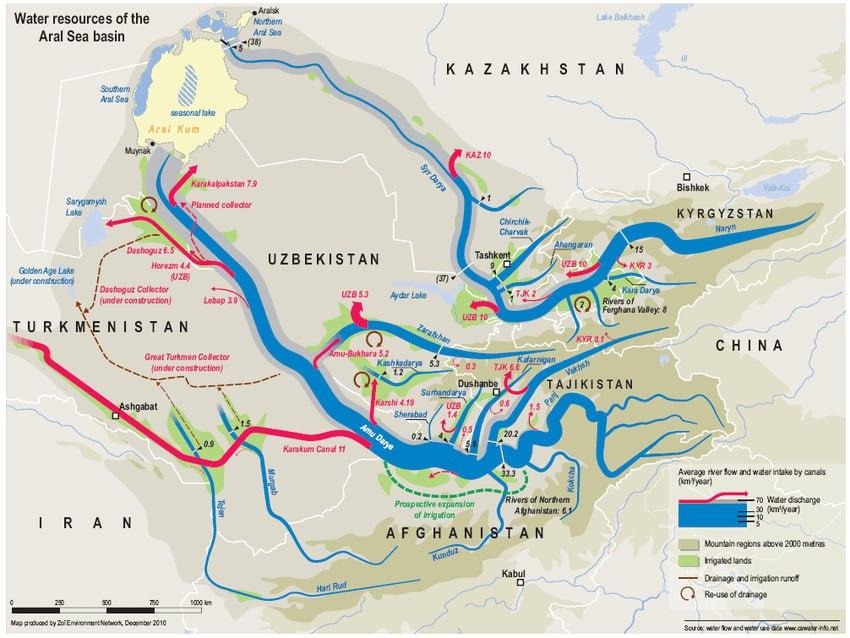
Source: IFAS, Executive Committee of the International Fund for Saving the Aral Sea. (2026). Basseyn Aralskogo morya. https://ecifas.kz/drugie-resursy/basseyn-aralskogo-morya. Used with permission.
Figure 2: Map of water abstraction in the Aral Basin. The Hungry Steppe is abstracted in the eastern portion of the Syr Darya River, near Tashkent.
Land reclamation was oftentimes justified for expanding cotton and wheat. Cotton in the late-Soviet period was used to supply both the textile and military industries. The intensification of cotton irrigation was accompanied by the re-distribution of society towards seasonal agricultural work. Students and urban professionals would be mobilized to harvest cotton in adjacent urban areas19. Over the 1960s, Khorezm and Qaraqalpaqstan experienced a particularly intense expansion of cotton, along areas formerly abandoned to archeological ruins and perennial wetlands. Zones that formerly supported non-agricultural livelihoods, like pastoralism and cairn irrigations, were transformed into collective farms20.
These land reclamation projects prioritised increased access to water over efficiency in irrigation. While it was assumed that best practices in water application and drainage would be developed in parallel, hasty quotas and vertical command structures lead to widespread water waste alongside rising mineralization of ground and surface water. Poor field leveling resulted in waterlogging in fields, where excess irrigation water is bogged in a field, and leads to increased salt content of the soil 21.
Canal works were uncemented and, amidst economic recession, poorly upkept, resulting in large water loss. These inefficiencies were a product of several factors- one was the hurried tempo of construction. Canals, like the Great Fergana Canal, were completed under hasty 5-years plans22 . Other systems, like the Karakum canal, were constructed under GULAG labor from those repressed in prison camps23.
By 1990, the Sea was 30% of its original size, having drastically receded from the former coastal ports. The sea’s recession put an end to the vibrant Aral fishing industry and left behind a desert of dried salts that were blown across the entire basin. Downstream areas were particularly hard hit. 75% of their land was salinized, childhood mortality was at 100 out of 1,000, and yearly losses of cotton due to salinization were estimated to be 0.5 million tons24.
Glasnost and Reactions to the Disaster
With the arrival of Glasnost in the mid 1980s, the Soviet government opened up about the country’s environmental mishaps. Amongst the first to speak were journalists and popular writers25.Although overly idealistic about the prospects of restoring the Aral Sea, they encouraged a national push for accountability from Moscow. Journalist Otkir Hashimov openly criticized the sloppily constructed infrastructure and excessive cotton demands whilst popular writer Sagdulla Karamtatov wrote an allegorical novel bemoaning the environmental exploitation of Central Asia by the USSR. Meanwhile, high profile Uzbekistani ex-pats, like Rusi Nasir spread the word about the Aral Crisis among laymen aboard26.
Many researchers revealed some level of complicity in keeping quiet about the crisis for so long. Scholars covered in this paper, such as Viktor Dukhovny and O.I. Subbotina, were affiliated with SANIIRI, the leading water research center of Central Asia, and would have been aware of the Aral Crisis much earlier. Scholar Leonid Elpiner admitted that data on the health consequences of the Aral Crisis had been gathered in the 1960s, but were only allowed to be publicized in the mid 1980s. Similarly, an account of consequences of the Aral Crisis published by a team of hydrometeorologists under Tatyana Molosnova in 1987 discussed research on the meteorological effects of the Aral Crisis being conducted since the 1960’s. The data they present makes strides in depicting the massive geographical scope of the crisis, as evidence of climate change is found as far as the Fergana Valley27.
The uncertainty of the late 1980s also contributed to uncertain accounts of who exactly was to take charge of the remediation process, as evidenced in Ziyavitdin Akramov and Asom Rafikov’s 1990 book The Past, Present and Future of the Aral Sea, a comprehensive scientific prognosis on the crisis, published in 1990. While laying out the results of inadequate administrative planning of Central Asian irrigation projects, the authors make sure not to implicate the Communist system itself, and instead focus on what changes could be implemented through the Soviet apparatus. Consequently, the authors discuss ambitious, characteristically Soviet infrastructure projects promising to restore the sea by 2010. These proposals included ambitious projects such as diverting Siberian rivers into Central Asia, or building a complex damming system to move the remaining sea to a safe zone. They finished their book with a reassurance to the reader that “The unique waterbody of Central Asia – the Aral Sea – will live!”28.
Most bittersweet, perhaps, is The Aral Crisis, a collection of historical and scientific articles on the Aral Region, in which Boris Andrianov, whose 1969 book voiced support for Soviet irrigation projects, served as editor, along with the scholars Nikolai Glazovsky, Larisa Levina and Lyudmila Timoshuk. Their introduction displays a reversal in the rhetoric presented in Andrianov’s previous work. The authors openly admitted to a continuity between the current period of man-made desertification and previous periods of environmental decay in Central Asia. As before, they propose to look into the region’s ancient history of water systems for a solution29.
Present and Future Challenges
Today, the downstream Amu Darya is facing dire desertification. Salt winds, combined with the continual evaporation of surface waters, have dramatically increased the area of salinized soil, affecting groundwater supplies in the region. The subsequent decline in economic opportunities has been recognised as a primary driver of increased emigration30.
Despite this difficult situation, there have been several positive developments in recent years, as both Uzbekistan and Qazaqstan recognise the need to improve the environmental situation. Several current development projects reinvestigate traditional ways of dealing with water in order to inform resilient practices31. Under new initiatives like the Aral Summit, government officials employ culture professionals to promote discourse on Qaraqalpaqstan as a heritage-scape, whose tourism potential and unique story of resilience in light of desertification offer opportunities for new livelihoods.
Local NGO initiatives like the Kiva Center, and the World Aral Region Charity, with which the author of this article works, explore mechanisms for motivating water efficient practices from below. Technologies like drip irrigation and desalination, though popular, lack sufficient community trust and buy in. We study these frictions in adoption and seek water efficient practices that are more viable for rural farming communities.
Nevertheless, one should be careful in the interplay between policy and reality, as revealed by the long-term heritage of hydraulic societies in the lower Amu Darya Basin. As much as the lower Amu Darya Basin carries traces of settlement and irrigation, so does it carry traces of desertification and emigration. Soviet scholarship paid most attention towards histories of irrigation and settlement, thus justifying disastrous land reclamation projects around the Aral. We propose policy and academia to strive for hydraulic relations that reflect past nature-cultures’ resilience to both scarcity and abundance in water. A resilient society should then seek to build futures that safely co-inhabit a wet and dry basin.
Endnotes
- (Yahya Gulyamov, 1957; Boris Andrianov, 1969)
- (Boris Andrianov, 1969)
- (Vadim Dukhovny, 2011)
- (Utkir Abdurasulov, 2016)
- (O. A. Shkapski, 1900)
- (Matthew Peterson, 2016)
- (Alexander Kaulbars, 1881)
- (Wilhelm Kuhn, 1910)
- (Utkir Abdurasulov, 2016; Akira Shioya, 2023)
- (Zokir Akramov & A. A. Rafikov, 1990)
- (Matthew Peterson, 2016)
- (Vadim Dukhovny, 2011)
- (Philip Micklin, 1991)
- (Boris Andrianov, 1969, p. 232)
- (Boris Andrianov, 1969, p. 232)
- (Paolo Conti, 2004)
- (Vadim Dukhovny, 2011)
- (Matthew Peterson, 2016)
- (Paolo Conti, 2024)
- (Vadim Dukhovny, 2011)
- (Vadim Dukhovny, 2011)
- (Elisabeth Brite, 2024)
- (Paolo Conti, 2004)
- (Philip Micklin, 1991)
- (R. Nasar, 1989)
- (T. I. Molosnova et al., 1987)
- (Zokir Akramov & A. A. Rafikov, 1990, p. 138)
- (Boris Andrianov et al., 1991)
- (G. Jarylkasinova & I. R. Mavlyanov, 2020)
- (Paul Maughan, 2025)
Bibliography
Abdurasulov, U. (2016). The Aral region and geopolitical agenda of the early Qongrats. Eurasian Studies, 14(1–2), 3–36. https://doi.org/10.1163/24685623-12340016
Akramov, Z. M., & Rafikov, A. A. (1990). Proshloe, nastoyashchee i budushchee Aralskogo morya. Mehnat.
Andrianov, B. V. (1969). Drevnie orositel’nye sistemy Priaral’ya. Nauka.
Andrianov, B. V., Glazovsky, N. F., Levina, L. M., & Timoshuk, L. A. (Eds.). (1991). Aral’skii krizis. Academy of Sciences of the USSR.
Brite, E. B. (2024). The hydrosocial empire: The Karakum River and the Soviet conquest of Central Asia in the 20th century. Journal of Anthropological Archaeology, 52 (2018) 123–136. https://doi.org/10.1016/j.jaa.2018.08.003
Conti, P. J. (2004). The ties that bind: The traditional irrigation systems of Uzbekistan, social capital, and implications for current, successful management (Doctoral dissertation, University of Montana).
Dukhovny, V. A. (2011). Water in Central Asia: Past, present, future. CRC Press.
Gulyamov, Y. (1957). Istoriya orosheniya Khorezma s drevneishikh vremen do nashikh dnei. Academy of Sciences of Uzbekistan.
Jarylkasinova, G., & Mavlyanov, I. R. (2020). Epidemiological analysis of the prevalence of iron deficiency anemia in the Republic of Uzbekistan for 2007–2019. Global Journal of Medical Research, 20(17). https://doi.org/10.17406/GJMR
Kaulbars, A. V. (1881). Nizov’ia Amu-Dar’i, opisannyia po sobstvennym issledovaniiam v 1873 [The lower Amu-Darya, described according to personal investigations in 1873]. Zapiski Imperatorskogo Russkogo Geograficheskogo Obshchestva, 9. St. Petersburg.
Kun, A. L. (1874). Poezdka po Khivinskomu khanstvu v 1873 g. [A journey through the Khivan Khanate in 1873]. Izvestiia Imperatorskogo Russkogo Geograficheskogo Obshchestva, 10, 47–58.
Maughan, P. (Ed.). (2025). ARAL: Untold stories from before, during and after the sea. Uzbekistan Art and Culture Development Foundation.
Micklin, P. P. (1991). The water management crisis in Soviet Central Asia. University of Pittsburgh Center for Russian and East European Studies.
Molosnova, T. I., Subbotina, O. I., & Chanisheva, S. G. (1987). Klimaticheskie posledstviya khozyaistvennoi deyatel’nosti v zone Aralskogo morya. Geometeoizdat.
Nasar, R. (1989). Reflections on the Aral Sea tragedy in the national literature of Turkistan. Central Asian Survey, 8(1), 49–68. https://doi.org/10.1080/02634938908400657
Peterson, M. (2016). US to USSR: American experts, irrigation, and cotton in Soviet Central Asia, 1929–32. Environmental History, 21(3), 442–466. https://doi.org/10.1093/envhis/emw006
Shioya, A. (2023). Irrigation policy of the Khanate of Khiva regarding the Lawzan Canal (1830–1873). Tsukuba University Journal of Area Studies, 32, 115–136.
Horizons